‘More than kin and less than kind’
 15 September 2015
Filed under Book Reviews
Tags: The Broke and the Bookish, Top Ten Tuesday


This week over at the Broke and Bookish the Top Ten Tuesday is a freebie – which basically means you can come up with whatever idea you like. My topic this week is fictional families. From comedic to vampiric, brought up by animals or members of nobility who simply act like animals. Fantasy families:
- The Cratchits from Charles Dickens Christmas Carol – a great family, poor in money, rich in love.
- The Weasley’s from J K Rowling’s Harry Potter – a great family – again, they haven’t got two pennies to rub together but they’re an excellent family and bring great entertainment value to the series.
- The Bennetts from Jane Austen’s Pride and Prejudice. The beleaguered Mr Bennett with his five daughters. Not to mention his rather loud wife. I was always puzzled how the two of them ever would have got together. (Ahem, not really fantasy, but….)
- The Scotts from M L Brennan’s Generation V series. This is a very unusual family – they’re all vampires. The head of the family is the now aged Madeline, the family matriarch who doesn’t suffer fools. The children, Fort – who is only just really starting to feel his true vampire self. His sister Prudence. A total maniac who terrifies all the other supernatural critters in the series and their elder brother Chivalry.
- The Lannisters from GRRMartin’s Game of Thrones series – could you have a more odd family! They really don’t need any introduction do they?
- The Cassels – a family of curse workers, each with different abilities, highly illegal of course, which gets them into a lot of trouble. Holly Black’s curse worker series.
- Merricat, her sister and uncle – the remaining Blackwood’s from Shirley Jackson’s We Have Always Lived in the Castle. These three are the only surviving members of an arsenic attack. I won’t elaborate as it would ruin the plot. All I will say is that Merricat is a very strange creature in deed.
- Coraline’s ‘other’ family in the book of the same name by Neil Gaiman. Very good example of being careful what you wish for.
- Mowgli from Rudyard Kipling’s Jungle Book. Brought up by wolves and with a bear and a panther as mentors. A very unusual family indeed.
- The Adam’s family – I had to have them. Wednesday and Pugsley, Cousin It, Uncle Fester – one of the strangest and darkest families ever – but I would have loved to pay them a visit for some strange reason.

Kushiel’s Chosen by Jacqueline Carey, readalong, final chapters
13 September 2015
Filed under Book Reviews
Tags: Jacqueline Carey, Kushiel's Chosen, Readalong
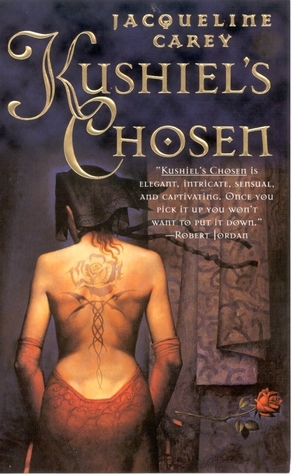 Today is the final week of our readalong for Kushiel’s Chosen. This week Emily at Emma Wolf is hosting. As you would expect – spoilers lurk below – so beware. Please feel free to jump in on the comments (clearly it’s a bit late to join in the readalong!). However, we are proposing a readalong for book No.3 and all are welcome so if you want to join that readalong then let me know in the comments and we can add you to the list. This week’s questions and answers below:
1. Earlier in the book, Phedre promised to rid the temple of Asherat of corruption. Here we see her speaking for the goddess. Is this what you had in mind? Is Phedre channeling the goddess or using her own words? Was her act a sign from the goddess, as Cesare Stregazza said, or merely a trick, as Marie-Celeste said? (I realize this is very similar to Lynn’s question from last week. I read ahead and wrote these questions early. I flatter myself to think that great minds think alike.)
Haha – I like this question – I think it’s good that we look at this again with the benefit of having now read it. Yeah, I don’t think she’s channeling the goddess to be honest – she’s using her own words, in fact, didn’t she mention something about having been practising what she was going to say just before she stood up? Even so, her actions have the same effect and do actually help to cleanse the temple. I do think that Phedre feels she has made a connection with Asherat and more than that she has made a promise to help and that’s what she feels she’s doing.
2. Ysandre offers (or demands) to take Imriel into her own household to spare him the “taint” of being a traitor’s son. What do you think of this? Would an Imriel raised by Ysandre be welcomed by the people as the heir to the throne? Or would the people remember Melisande’s treachery when they see her son?
I thought that was such a great gesture. How well it would work would remain to be seen but I think if anybody is capable of undertaking that in the proper spirit it would be Ysandre. As to being welcomed by the people – I think so actually. I think they would see the example set by Ysandre and would probably be happy with her actions and follow her lead. It’s the nobility that would probably have more of a problem. They seem to be the one who hold very long grudges. They have more at stake after all – money, favour, lands – and they’re always positioning so to have a child of Melisande on the throne could possibly cause division – we’ve learnt that some of the nobility don’t like Ysandre’s choice of partner for example. They would probably seek to overthrow Ysandre at any opportunity to raise Imriel up. And there could be others who have an eye on the throne themselves and so wouldn’t take kindly to Melisande’s child being raised to that purpose.
3. What do you think of Melisande taking sanctuary in the temple to Asherat and the Doge allowing it? Is it blasphemous? Ysandre asks Phedre what she can expect from Melisande, and Phedre cannot answer. What do you expect from Melisande?
I just knew she’d wriggle out of trouble somehow. She always has all her bases covered and even now – she’s not going to be worried. She is constantly thinking of how to manipulate a situation. She’s safe, her son is safe so her end game will still be the same. We know that she won’t take defeat so it stands to reason that she’s now thinking of another way to get her son on the throne. As to the Doge allowing her to take sanctuary. I think that he’s also edging his bets. Melisande has a son who could be the next heir – it doesn’t really do to burn all your bridges and clearly she has supporters. For me, he’s just keeping his options open and waiting for the best time to jump so he can see what direction to jump in.
4. After seeing his fellow Cassiline Brother attempt to assassinate their charge in La Serenissima, Brys no Rinforte is badly shaken and is unable to accompany Ysandre through the Royal Army and into the City of Elua. What do you make of this? Phedre called it “defection,” which, according to dictionary.com, has two meanings: 1) desertion from allegiance, loyalty, duty, or the like. Apostasy; and 2) failure, lack, loss. What do you think of Phedre’s description? Phedre also tells us that Ysandre dismissed the Cassilines from her service. What share of the blame does Brys deserve for Ysandre’s decision? What do you think of the irony that Cassiline Brothers have become more popular among D’angelines?
It was unusual and even now I’m not quite sure what to make of it. I’m not sure whether Rinforte was suffering from similar feelings to those we’ve often witnessed in Joscelin where he beats himself up over any type of failure. Or, whether there’s something else underlying it and he actually was more aware of what was going to happen and has actually defected – in the way of changing allegiance. If this was Joscelin, for example, I think he would be suffering tremendous guilt but I also think he would want to make reparation so I think he would want to accompany Ysandre into Elua. It makes me wonder whether Rinforte has jumped ship. You can’t really blame Ysandre for dismissing the Cassilines – it must feel like a terrible betrayal to have those that you trust so implicitly turn against you. I think Ysandre will need to chose very carefully from now on those people that she chooses to to surround herself with.
5. The Rebbe Nahum ben Isaac said “you Children of Elua are too quick to forget how the love you invoke may cut like a blade.” What do you think? Is Elua a gentle, loving god or is the rebbe right?
I think this is a great question. it raises the ups and downs and upsets that Phedre and Joscelin have been inflicting on each other. This whole idea of free love for example, it’s an ideal but it’s difficult to completely sign up to. At the end of the day it would be difficult to share somebody who you love, at least I think it would. I think the Rebbe makes a very clever remark for more reasons than one. It is easy to hurt someone you love – as we’ve seen with Joscelin. Also, I think to an extent, the ‘children of Elua’ are perhaps a little bit imperious in that they seem unaware of the love they inspire in others and therefore the fact that they have the ability to hurt those people without even really being aware of it. Joscelin is more often than not completely unaware of the feelings he creates in others and Phedre, whilst I think she is more aware of the feelings she creates in those around her, seems quite detached from the pain it might inflict. Not that I’m implying that she would deliberately inflict pain on somebody, it’s more that she doesn’t seem to recognise that people will become attached to her.
Other participants:
Allie at Tethyan Books
Lisa at Over the Effing Rainbow
Grace at Books Without Any Pictures
Nancy at FaeStruck’s Reviews & More
James at James T. Witherspoon
Emily at Emma Wolf
Susan at Dab of Darkness
Bibbity. Bobbity. Boo
This week over at the Fantasy Review Barn we are once again traversing the tropes of fantasy with our trusty guide Nathan
This week’s topic is MAGIC SYSTEMS.
Without further ado. And with an excuse about my brevity this week: I’m having IT problems and so this is all from my phone! Expect errors and you will probably not be disappointed. So:
- Mistborn by Brandon Sanderson. In which allomancy is used and people ingest small amounts of metal which acts like a fuel to their particular type of magic.
- The Tiffany Aching books by Pratchett. Good old fashioned witchcraft with broomsticks and witches living in hovels (Sometimes)
- Harry Potter. Ditto the above but set in a huge ass school with bucket loads of students all learning spells and enchantments/potions. Wands and broomsticks are all the rage. The students even have their own familiars, although I don’t fancy having a rat!
- Feast of Souls by C S Friedman. This is a very unusual magic system in which the magic user chooses and connects to another individual. Their power therefore comes from that person’s life energy. Nasty eh!
- Sunshine by Robin McKinley in which the main protagonist gains power from the sun. (I guess the clue is right there in the title!)
- Strange and Norrell by S Clarke. In which there is an alliance with the fae.
- Similarly. Sorcerer to the Crown by Zen Cho involves magic which is fuelled by the fae.
- Flex by Ferret Steinmetz. This is an intriguing system in which the people with magical ability manifest the strangest abilities unfortunately their magic creates something called the Flux. Which is a bit like a nasty byproduct of the magic and can be very dangerous unless dealt with carefully.
- The Bondsmagi from Scott Lunch’s Gentlemen Bastards. I don’t know exactly how their magic works but I do know that they need their hands and their tongues in order to conjure!
- God given? Kushiel’s Dart/chosen by Jacqueline Carey. In which Phedre is chosen by a god. She perhaps doesn’t seem overtly magical unless being able to manipulate people into giving you what you want is magic.
That is all for me this week.
“Expeliarmus”
Sorcerer to the Crown by Zen Cho
 Just finished reading Sorcerer to the Crown which I thoroughly enjoyed. This is a great combination of Regency period manners and fantasy written in a very easy to read and accessible style.
My first thoughts upon starting this read were of a sort of mash up of Pride and Prejudice and Strange and Norell, but, let me be quite plain, this is not written in either the style of Austen or Clarke and Cho is in no way trying to mimic either of those authors. So, if your taste doesn’t run to old fashioned language and bonnets or lengthy footnotes and extensive descriptions of Regency England but you would like to read a period drama that brings a bit of intrigue and a touch of romance, takes a fairly bald look at a few of the restrictions and prejudices of the time and then places the society into chaos then look no further. There is magic, there are attempted assassinations, there are talking familiars, trips into the land of the fae and flights of fancy atop the clouds. And more.
Characters. Well, we have Zacharias, A freed slave who has unwittingly risen to the position of Sorcerer Royal of the Unnatural Philosophers. To say this is a source of displeasure to some of the eminent magicians within that Society would most definitely be an understatement. There are whispers and mumblings and things don’t look too good for Zacharias. On top of this the magic seems to be in decline. The border to the land of fairy is shrinking and the flow of magic in between the two worlds seems to be considerably reduced. Zacharias needs to take measures to restore the balance. We also have Prunella Gentleman, a wonderful name for a woman of mixed race who has also been at the receiving end of prejudice. Prunella is an orphan, even untrained she seems capable of great magical displays. She’s been brought up in the care of a woman who runs a boarding school for young ladies (of magic). This of course brings us to the other restrictions of the time. Women couldn’t possibly carry out magic – they’re far too fragile and delicate to attempt such a feat, in fact it appears to be more acceptable that they perform almost death like rituals to remove their magical ability rather than use their ability (and quite potentially be as good if not better than the men of the time).
In a strange twist Prunella goes off to London under the care and tutelage of Zacharias – he’s going to help her come ‘out’ into society, indeed he’s going to help her to catch a husband. Because, it is a truth universally acknowledged, that a single woman in possession of immense magical ability must be in want of a wealthy husband! Is it not?
I can’t really give too much of the plot away but I can say that the story moves forward at a great pace with never any opportunity for a dull moment.
What did I really like about this. I enjoy reading stories set in a different period, particularly Regency. I like that this story turns the period onto it’s head a little bit. We’re damn well looking at the inadequacies of the time and that’s that! I enjoyed that we have such unusual circumstances such as Zacharias, freed from being a slave, now holding the most prestigious and sought after role in the country with great magical power at his fingertips. And we have Prunella, a half caste woman with an extraordinary ability to weave magic who is completely capable of walking into any situation and handling herself admirably and is about to revolutionise the role of women in the magical field. On top of that, I’m always happy to meet the inhabitants of fairyland and see what antics they’re getting up to – and, let’s face it we have a number of wonderful creatures who play a role. And, as if you needed any more incentive there is plenty of witty dialogue and moments of exasperation between the two main characters which is very amusing to read.
In terms of criticisms – nothing major to be honest – I think there was an element of the solution to Prunella’s problems being glaringly obvious – but that isn’t really an issue that detracted at all and it was actually quite enjoyable working up to the eventual outcome.
This is a quirky kind of read. I found it quick and fun and I will definitely continue with the next in series.
I received a copy courtesy of the publisher through Netgalley for which my thanks. The above is my own opinion.
You can run but you can’t hide!
7 September 2015
Filed under Book Reviews
Tags: The Broke and the Bookish, Top Ten Tuesday, Unfinished Series
This week over at the Broke and Bookish the Top Ten Tuesday is:
Ten Finished Series I Have YET to Finish
Yes, this week’s topic is finished series – that I haven’t yet finished reading!! I wrote this (shamefaced) post some time ago and I have been trying to cross some books off the list – unfortunately at the same time I’ve been crossing off I’ve also been adding more. However, as I haven’t put the new series on the list yet I refuse to feel guilty about them. Without further ado my 10 unfinished series:
- Timeless by Gail Carriger – already read Soulless, Changeless, Blameless and Heartless
- The Descent by Alma Katus – already read The Taker and The Reckoning
- Dust by Hugh Howey – already read Wool and Shift
- The Merchant of Dreams and The Prince of Lies by Anne Lyle – already read The Alchemist of Souls
- Monsters by Ilsa Bick – already read Ashes and Shadows
- Bitterblue by Kristin Cashore – read Graceline and Fire (not altogether a series but based in the same world – and have now started reading this one!)
- The Book of Life by Deborah Harkness – already read A Discovery of Witches and Shadow of Night (in truth I’ve actually gone off this series a little)
- The Last Rite by Jasper Kent (No 5 in the Danilov Quintet) – already read Twelve, Thirteen Years Later, The Third Section and The People’s Will – I really need to finish this one.
- Outpost and Horde by Ann Aguirre – already read Enclave
- Shimmer and Burn by Paula Weston – already read Shadows and Haze


