Can’t Wait Wednesday : Skyward by Brandon Sanderson
 26 September 2018
Filed under Book Reviews
Tags: Brandon Sanderson, Can't wait Wednesday, Skyward, Wishful Endings


“Waiting On Wednesday” is a weekly meme that was originally created by Breaking the Spine. Unfortunately Breaking the Spine are no longer hosting so I’m now linking my posts up to Wishful Endings Can’t Wait Wednesday. Don’t forget to stop over, link up and check out what books everyone else is waiting for. If you want to take part, basically, every Wednesday, we highlight a book that we’re really looking forward to. This week my book is : Skyward by Brandon Sanderson. This sounds and looks excellent. I can’t wait. Due for publication in November 2018
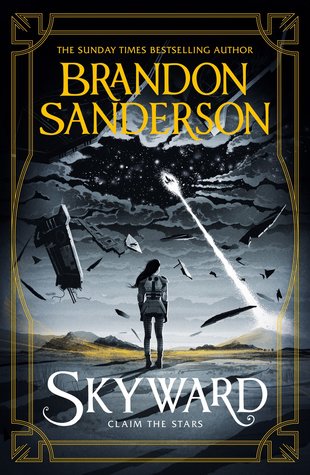 Defeated, crushed, and driven almost to extinction, the remnants of the human race are trapped on a planet that is constantly attacked by mysterious alien starfighters. Spensa, a teenage girl living among them, longs to be a pilot. When she discovers the wreckage of an ancient ship, she realizes this dream might be possible—assuming she can repair the ship, navigate flight school, and (perhaps most importantly) persuade the strange machine to help her. Because this ship, uniquely, appears to have a soul.
Some of my favourite female authors
25 September 2018
Filed under Book Reviews
Tags: That Artsy Reader Girl, Top Ten Tuesday

Top Ten Tuesday is a weekly meme where every Tuesday we look at a particular topic for discussion and use various (or more to the point ten) bookish examples to demonstrate that particular topic. Top Ten Tuesday (created and hosted by The Broke and Bookish) is now being hosted by That Artsy Reader Girl and future week’s topics can be found here. This week’s topic is:
Books By Some of My Favorite Authors That I Still Haven’t Read
I’ve decided to go all female for this week’s theme. Below is a list of author’s that I’ve loved in the past and would like to make time to read more from in the future:
- Agatha Christie – I’ve read a few of Agatha’s books but currently feel the need to pick up some more – I have a copy of And Then There were None which I hope to get to soon.
- Diane Wynne Jones – I loved Howl’s Moving Castle and a good friend bought me a copy of Charmed which I’d love to have chance to pick up.
- Seanan McGuire – The Toby Daye books are amazing and I seriously intend to catch up soon – I’ve read the first 8 and have A Red Rose Chain waiting patiently to be picked up.
- Patricia Briggs – similarly to the above (No.3) I really enjoy the Mercy Thompson books, again, I’ve got as far as No.8 so have Fire Touched to look forward to. Note to self to catch up.
- Donna Tartt – The Secret History is one of my all time favourite books so I’m not sure why I haven’t yet picked up The Goldfinch – well, apart from the fact that time is elusive of course.
- Daphne DuMaurier – Rebecca is another one of my all time favourite reads, Plus Jamaica Inn and My Cousin Rachel. I need to pick up more books by this author and particularly fancy The House on the Strand.
- Kate Atkinson – I’ve read a number of Ms Atkinson’s books and thoroughly enjoy her work, particularly Case Histories and Life After Life. I believe there is a new book on the horizon called Transcription which sounds really good.
- Lisa Tuttle – I love the recent Jesperson and Lane supernatural mystery series, I think there are only two released to date so I have my fingers crossed that more are in the pipeline.
- Tracy Chevalier – I’ve read quite a few of this author’s books and loved Girl with a Pearl Earring and Remarkable Creatures. I’m really looking forward to seeing what she comes up with next and in the meantime I would also like to catch up with At the Edge of the Orchard.
- Maggie O’Farrell – I think I’ve read about 6 of this author’s books so far. My absolute favourite is After You’d Gone and I very much like the sound of This Must Be the Place.
- Sarah Pinborough – I’ve read about 10 or 11 books by this author. I don’t know what she’s currently working on but whatever it happens to be I am in for the count.


The Sisters of the Winter Wood by Rena Rossner
24 September 2018
Filed under Book Reviews
Tags: Rena Rossner, The Sisters of the Winter Wood
 The Sisters of the Winter Wood is quite a bewitching little story. I would say that it wasn’t exactly what I imagined when I initially requested a copy and yet I feel it worked really well for me even if it did stray more heavily into the area of romance than I normally like. Strangely enough, in spite of the fairytale feel and the use of folklore this is a story with a serious heart that isn’t afraid to tackle issues. At the same time it’s a sneaky little number because I think it works on many levels. There’s certainly plenty of food for thought here and Rossner doesn’t shy away from difficult topics but at the same time I think you could read this quite simply as a fairy story with the elements that you’d expect such as the house set deep within the woods, the parents who have to leave the two daughters to fend for themselves, etc.
The story begins with an introduction to two sisters Liba and Laya. They live a sheltered life with their parents, a happy existence although the beginnings of unrest are beginning to creep into their lives, troubling times ahead for Jewish people in particular. At short notice Liba and Laya’s parents are called away on urgent family business and the two sisters are left to fend for themselves.
I’m not going to delve into the storyline too deeply because there were certain aspects of this that were surprising and they were elements that I found myself really enjoying, particularly the shape shifting. In fact that’s the one element to the story that really feeds into the darkness and serves eventually to cause the two sisters to become less close – but more of that in a moment.
This is going to be another review of thoughts.
Firstly the two sisters. They both love and care for each other and a lot of the narrative is hinged upon this. At the same they’re quite different in nature, one sister’s nature running to strength and the other sister’s nature being somewhat more flighty. Liba takes after her father and Laya takes after her mother. I will say that this aspect of the story really resonated with me. I have an older sister – although she’s barely older than I am and in fact we were both born in the same year. My sister was constantly likened to our mum and I was frequently told how alike I was to my dad and to be honest, at that age it’s not particularly something you want to hear so I could relate well to Liba. She suffered from doubt about her looks, her weight and about her own place in the family dynamic but, in spite of that her love for Laya remained firm. During the read I didn’t like Laya as much as Liba. I think the author was going for a fragility of nature that I tend to find a little annoying and on top of that her feelings towards her sister never came across as well not to mention she made a number of rather dubious decisions that made me want to shake her. That being said I would say that this tale has not so much of a coming of age feel as a sexual awakening. With the parents removed and the introduction of more freedom both of them become much more aware of the men within their environment and so when a troupe of handsome young fruit sellers enters the scene, well you know things are going to spiral out of control fairly quickly. Added to this are the family secrets and the secrets that the girls are keeping from each other in a bid to try and protect one another from harm. A lack of communication that in the long run proves to be quite costly.
Alongside of this is a storyline inspired by the Goblin Market. A tale of deception with goblins and glamours and honeyed fruit that belies it’s true nature. And on top of this is a historical feel to the story in terms of the actual unrest that was taking place at the time revolving around the Jewish people and the hardships that were looming.
I really enjoyed the writing but then I do like fairytales and anything that has foreboding forests and people that can change into creatures instantly wins me over.
In terms of criticisms. There is quite a lot of romance although I didn’t particularly mind it – just worth a mention particularly as it felt a little rushed in some respects. The real issue that gave me pause for thought was that the underlying story here is one of persecution, about people’s fears and insecurities and the way in which these can be used to cause unrest. I suppose to some extent it almost feels like this setting, with its fairytale feel, is almost inappropriate for such a heavy topic and yet upon reflection I think I appreciated that the author was using this medium and it’s many metaphors to tell a story that was fantastical whilst at the same time being historical. This is a story that has many messages and I think it will appeal differently to varying ages for that very reason. The romance has a YA feel, there are beautiful glamorous boys, forbidden fruit and dangerous liaisons, there are the dark woods and the creatures stalking them but then there is the whole feeling of a period suffering from turmoil and unrest.
All told I enjoyed this. I can’t deny that it’s quite different from what I expected but in a good way. As with all fairytales it’s a strong message wrapped up a a golden nugget of storytelling and with a hopeful ending to conclude upon.
I received a copy through Netgalley, courtesy of the publisher, for which my thanks. The above is my own opinion.
Weekly Wrap Up : 23rd September 2018
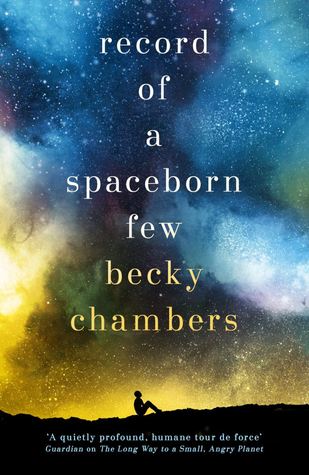
I didn’t do as well this week with my reading and blogging, primarily because we’ve had friends staying which has been really lovely. I’ve read Becky Chamber’s latest book. Read about 20% of Chris Wooding’s Ember Blade and also started Dracul. So, here’s my weekly wrap up:
My books:
- Record of a Spaceborn Few by Becky Chambers
Next week’s reads:
- The Ember Blade by Chris Wooding
- Creatures: The Legacy of Frankenstein by Emma Newman; Tade Thompson; Paul Meloy; Kaaron Warren; Rose Biggin
- Dracul Dacre Stoker; by J. D. Barker


Upcoming reviews: –
- Starborn by Lucy Hounsom
- Envy of Angels by Matt Wallace
- Noir by Christopher Moore
- The Burning Chambers by Kate Mosse
- Dark Water by Elizabeth Lowry
- The Sisters of the Winter Wood by Rena Rossner
- Trail of Lightning by Rebecca Roanhorse
- Record of a Spaceborn Few by Becky Chambers
I’d love to know what you’re reading this week.
#SPFBO Guest Post: Finding Fairy Tales by A M Justice
22 September 2018
Filed under #SPFBO, Book Reviews
Tags: #SPFBO 2018, A Wizard's Forge, AM Justice, Rapunzel
Today, I’m really pleased to welcome to my blog the author of A Wizard’s Forge: Amanda Justice. Amanda has written a post about the inspiration for her book A Wizard’s Forge which will be one of my upcoming reads for the Self Published Fantasy Blog Off. A Wizard’s Forge is a deconstructed version of Rapunzel. If you know anything about my blog you’ll know I love fairytale retellings so excitement am I to read this post:
 ‘Sometimes inspiration is like a beacon, drawing the author toward her goal. Other times, the influence is a sleeper agent that infiltrates the subconscious and adds unexpected layers to the narrative. My SPFBO 2018 entry, A Wizard’s Forge, is a retelling of “Rapunzel,” but not necessarily one I set out to write.
Because we’re usually introduced to fairy tales as children, and we hear or read them over and over, they tend to embed themselves in our consciousness. They also frequently portray universal themes—fairy tales from different cultures all over the world often carry similar messages about compassion or justice. I think the universal nature of these stories is why bookstore shelves are loaded with fairy tale retellings. Western folk tale–inspired stories tend to dominate English-language fantasies, including modern-day classics such as Gail Carson Levine’s Ella Enchanted (“Cinderella”) and Fairest (“Snow White”) and Shannon Hale’s Books of Bayern (starting with Goose Girl) as well as the recent novels A Dance of Silver and Shadow (“The Twelve Dancing Princesses”; an SPFBO 2018 entry) by Melanie Cellier and Spinning Silver (“Rumpelstiltskin”) by Naomi Novik. But fairy tales turn up in other genres too. Marissa Meyer’s Lunar Chronicles (Cinder [“Cinderella”], Scarlett [“Little Red Riding Hood”], etc) are set in a high-tech, dystopian future and feature cyborgs as the protagonists. Jane Rosenberg Laforge’s Hawkman (“The Bearskin”) takes place in post-WWI England and is more magic realism than fantasy. Roxane Gay’s An Untamed State (“Rumpelstiltskin”), set in modern day Haiti, is straight contemporary fiction and doesn’t contain any magic at all.
“Rapunzel” nestled down in the bedrock of my psyche and from there bubbled up into the making of A Wizard’s Forge. The inspiring elements were melted and remixed in the idea cauldron, so the source material may not be as obvious as it is in other retellings. On the surface, A Wizard’s Forge is a science fantasy about a young woman’s quest for vengeance. The setting on a lost space colony is inspired by Anne McCaffrey’s Pern, and the fantasy creatures (i.e., aliens) are directly descended from 1950s sci fi films featuring giant insects (e.g., THEM!). The story deliberately subverts a lot of fantasy tropes, starting with a damsel in distress who saves herself, then tries to save a prince. In addition, Victoria, the heroine, might be a chosen one, and she’s given a special talisman before departing on a quest to defeat an evil high lord. Where the book departs from high fantasy is that the lord’s power is psychological, not magical. He holds Vic captive at the beginning of the story, and her desire to avenge herself is complicated by a case of Stockholm Syndrome. There’s also a long war, a clash between religion and atheism, those giant intelligent insects mentioned above, and a taste of wizardry, which in Vic’s world is a mysterious power that is usually lethal to those who try to wield it.
I know what you’re thinking: that doesn’t sound anything like Rapunzel!
 But it is. Rapunzel involves a girl with very long hair who is held in isolation in a tower by a powerful, jealous person. A prince finds the tower, sneaks in, and he and the girl fall in love. Discovering them together, the enraged captor throws the prince out a window into a patch of nettles. Blinded, he wanders off into the wilderness. After shearing off the girl’s hair, the captor magically banishes her to another land. Eventually, the prince and girl find each other, and her joyful tears wash the nettles from his eyes, restoring his sight.
All of that is in A Wizard’s Forge:
- A powerful person is obsessed with Vic and keeps her locked up by herself in a tower.
- Vic has long hair that is central to her identity; her captor cuts it off.
- A harrowing event centers around the tower window.
- Vic’s sexual awakening has dire consequences for herself and others.
- A jealous rage provides an opportunity for escape.
- There’s a prince.
- Someone goes blind.
- There’s a separation and a reunion.
As Jo Niederhoff recently discussed on Fantasy Faction, fantasy and fairy tales share many common tropes and themes, such as the hero’s journey, hidden royalty, and magic, all of which turn up in A Wizard’s Forge as well. But some important differences between fairy tales and fantasy are worth noting. In his essay “Tree and Leaf,” J.R.R. Tolkien explained the idea of “secondary belief,” in which fantasy authors must construct their worlds in such a way that readers believe the story while they’re immersed in it, whereas fairy tale tellers don’t need to explain anything. Donald Haase, editor of the Greenwood Encyclopedia of Folktales and Fairy Tales, echoed this idea by saying belief is the main difference between fantasy and fairy tales. Fairy tales aren’t necessarily made to be believable, because the goal isn’t immersion but instruction. The fairy tale is like a didactic lecture or sermon, meant to impart wisdom or knowledge. A fantasy, however, is a philosophical discussion between author and reader in which the reader must accept the author’s premise to understand the author’s observations and message. Fairy tales teach; fantasies enlighten.
Whoa! Enlighten—that’s a rather highfalutin notion, isn’t it? I’d argue that the fantasy genre encompasses a wide range of fiction, from purely escapist, easy reading pulp to literary masterworks. Regardless of where a book falls on that spectrum, by simply positing societies and individuals that are different from us or approach problems differently, fantasies force readers to think about the world in new ways, opening the door to epiphanies about how our world works. That was certainly my goal when I wrote A Wizard’s Forge, and I think the elements from “Rapunzel” that infiltrated the story helped me achieve it.
For more information about Amanda and her book:
Website: www.amjusticeauthor.com
Twitter: https://twitter.com/AMJusticeWrites
Facebook: https://www.facebook.com/AMJusticeauthor/
Goodreads: http://www.goodreads.com/author/show/6903962.A_M_Justice

Thank you Amanda for providing me with this great guest post. I’m really looking forward to picking your book up and wish you all the best with the SPFBO.


 Books and travelling with Lynn