The Chrysalids by John Wyndham
 22 March 2018
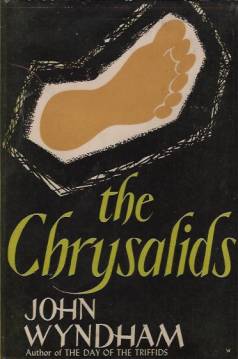 I read The Chrysalids in January as part of Vintage Sci Fi month and so I’m a little ashamed to be only just writing a review. But, here goes.
This is my second Wyndham novel, The Day of the Triffids being my first experience of his work. To be honest, I hadn’t heard of this book but picked it up on the recommendation of other bloggers who rated it highly. For quite a short book it has a surprising impact and has aged remarkably well.
Whilst it’s not specifically referenced as such the world here is a post apocalyptic one. Nuclear war (known here as ‘Tribulation’) has happened and vast swathes of the world have been left uninhabitable. The people who inhabit Labrador live simple farming lives. Whilst they are familiar with the advances made by society pre Tribulation they hold no such aspirations towards modern inventions. They believe that Tribulation was an act of God and they practice an over zealous form of Christianity that allows no margin for difference.
The story follows David Storm. We make his acquaintance when he is still a fairly young boy as he makes friends with a young girl from the community called Sophie. This is when we first witness the true nature of the society in which David lives. Sophie has been born with a mutation, presumably an after effect of the nuclear fallout. She has six toes on each foot. Her family have kept this imperfection a secret but David unwittingly finds out. David agrees to keep Sophie’s secret, he likes her family and feels comfortable in their home, a loving family setting that is quite far removed from his own home life. David’s father is an important religious figure in the community and strictly enforces the doctrines at home. The religion practiced in Labrador has a very strict code of how a person should look and having a sixth toe definitely doesn’t fit within that code. Of course secrets have a way of wriggling into the open and eventually Sophie and her family have to go on the run. The story then moves forward, but not before we become aware that David is keeping a secret of his own, one that is made much more frightening when he witnesses first hand what becomes of people who differ. David is telepathic, and he’s not the only one.
The story then jumps forward in time. David and his friends have managed to keep their secret. In fact they’ve become quite skilled in telepathy forming a sophisticated way of communicating that relies on shape patterns and that conveys so much more than basic talking can do. Unfortunately, in spite of their cautious outlook a number of situations eventually occur and result in unfavourable attention falling in their direction and the group have to make the decision to go on the run before they are taken and questioned.
What I really like about this book is the way in which it’s written. Unsurprisingly, given that it was written in the 50s, it has a certain style that brings with it a sense of nostalgia. It simply isn’t a modern book and that much is patently obvious when reading it and yet the simplicity of the story has helped to prevent it becoming dated. It’s also a fascinating story that looks particularly at acceptance – or the lack of it in this case. The fear of anything that is different and the ostracisation of anything that doesn’t follow the norm. In the story there’s a place in the wild where all those who don’t fit in have settled. It’s a desperate and violent place, food is in short supply and the people there live harsh lifestyles. It’s over 60 years since this book was published and yet the message it delivers is still relevant.
There’s a dramatic finale that I really didn’t expect and at first that I felt almost jarred with the story in that it was so unexpected yet on reflection I find myself feeling that it fit in really well. Without giving too much away the final outcome involves people from another part of the world who are much more technologically advanced. Presumably Sealand, as it’s known in the book, was unaffected by the nuclear holocaust that affected many other parts of the world and in fact they’ve continued to advance. They eventually travel to Labrador as part of a rescue operation but this inevitably results in conflict. I admit that the conclusion was a bit sudden but then this is a fairly short story.
Overall I really enjoyed this. It’s a quick read that packs a punch. I cared about David – I cared about Sophie. I wanted to shout at people in this story to leave them alone! It was shocking to witness some of the events and the impact they had, it was almost like a witch hunt in terms of the feeling of hysteria that anything ‘different’ provoked. Definitely a book that I would recommend. This may be a fairly short story and a quick read but it carries a strong message that is pertinent and important.
Where I got the book: bought


 Books and travelling with Lynn