#SPFBO Saturday : Guest post from Bjørn Larssen
 26 June 2021
Filed under Book Reviews
Tags: #SPFBO, Bjorn Larssen, Book Covers, Guest post


As part of the SPFBO Competition each weekend I am hoping to post guest blog posts inviting authors taking part in the competition to visit my blog to either write an article, discuss covers, take part in an interview or post an excerpt or teaser for their work.
This weekend is my first visit and I’m really happy to be hosting a guest post submitted by Bjørn Larssen in which he discusses the thought processes that led him to come up with the wonderful cover we’re now familiar with. A cover that was also submitted into the SPFBO Cover Competition and won Silver place from the public vote. Bjørn is the author of Children (The Ten World #1). The description for which can be found here.
Firstly, I’d like to thank Bjørn for agreeing to take part and providing us with an insight into the amount of work that goes into putting together a successful cover.
***
Everything began with a shot of Meghan and Harry walking in front of photographers. Meghan, an actress, did the smiling and waving thing. Harry’s mouth formed a grimace, his best attempt at a smile. He gazed to the side, eyebrows furrowed. He was not holding Meghan’s hand; she held his.
Harry was never going to become King; he’d forever remain “the son of.” At best, potentially useful as a point of access to those who have actual power. He knew all that, saw no escape, knew this was going to be how the rest of his life would unfold, and he was terrified.
Magni, son of Thor, was neglected, cast away, ignored by his father. He was also a giant, flame-haired, bearded blacksmith who carried his favourite hammer around. He looked like the father he despised – and the last time he had seen Thor was when Thor had destroyed the town Magni and his mother lived in. Magni made a vow to become the opposite of Thor, rejecting everything his father stood for.
Someone like Magni could never be accepted as simply a strong man who likes working with iron though. He was not a person – but “the son of,” hated or loved at first sight, preconceptions about him made before it transpired he even had a name of his own. At best, potentially useful as a point of access to the “real” Gods. He knew all that, saw no escape, knew this was going to be how the rest of his life would unfold, and he was terrified.
I wanted Magni on the cover and now I knew what he should look like.
Portrait
Most covers of indie fantasy books are paintings. I had the blurb for the artist ready – here’s the photo. Give me those haunted eyes, the apprehension, add darkness and fire. I approached two artists whose earlier work I adored. When I received their price quotes, I slightly passed out. Those prices, when I thought about it, were completely reasonable, when compared with how much time and work it would take. But in order to afford their fees, I’d have to postpone the book by at least six months in order to save money.
The probability of me finding a model with red hair and beard, clad in medieval clothing, with that look in his eyes and the right facial expression, seemed near-zero. To my excited disbelief, I found him. I stared at the photos (there was a whole series!), picked one, bought it, and started working. The cover couldn’t just have Magni on it. It needed to convey the message “this is a Norse mythology retelling from the point of view of the son of Thor (pictured), oh, and despite the title it is also not at all suitable for children.”
I added layers – a flock of birds to represent Odin’s ravens; tree branches; fire. After consideration I took out the birds, because representing Odin’s two ravens using fifty or so bird silhouettes felt unclear even to me. I replaced the branches with an actual peek of a forest at night. Added more fire (when in doubt, always add more fire) for that fantasy je ne sais quoi. My inner graphic designer (I worked as one for nearly fifteen years) was delighted. As a reader, all I could tell was that it was a fantasy book that featured some bloke with green eyes. The only reason why I knew it had something to do with Norse Gods was that I wrote the book.
I tried various pseudo-runic fonts and cringed from here to New Zealand at how cheap they made the cover look. I changed the title to Children of the Gods, because Gods = possibly Norse Gods, might work. I showed the result to some people and all of them praised it – but they all already knew what the book was about.
But it was so pretty.
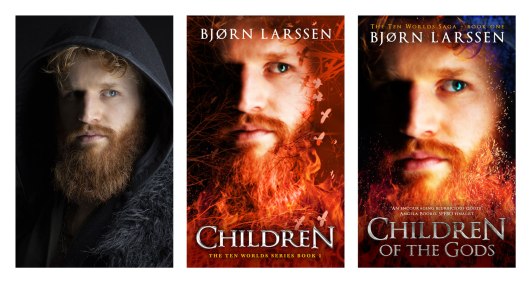 A few weeks before the release date a friend told me about a lengthy series of vaguely homophobic vampire erotica called Children of the Gods. Now I really had a branding disaster in my hands. Calling the book Children didn’t really explain what it was about, but getting it mixed up with a series of 46 (by now 51) vampire romances? The publishers of those had massive marketing budgets (and potentially a lawyer). My book would never appear in Amazon search above the 47th position. I was happy to go back to the original title – but now the cover again conveyed, without a doubt, that it contained a green-eyed man.
Trees
Children is the first book in The Ten Worlds series. I commissioned a logo for the series from Brad Bergman. It was supposed to appear on the spines and front covers, small, just for branding. When it arrived, I was blown away. It just fit, an illustration rather than a logo, Yggdrasil, the Tree of life, surrounded by clearly Norse symbols. I blew the logo up, placed it on a burgundy red background, made it golden, then replaced the gold with fire. (When in doubt…) The typography was simple, not to distract from the Tree. I barely bothered to say a quick “bye” to poor Magni.
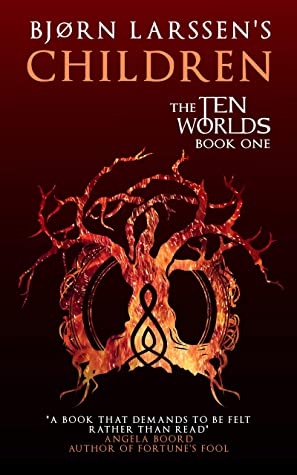
When the book came out, many of the reviewers couldn’t compliment the cover enough. It was a triumph. I loved it, the readers who followed me after Storytellers (my debut) loved it, and all seemed great until a stranger asked me what sort of book it was.
It didn’t occur to me that the reviewers were approached with the question “would you like to read a Norse mythology retelling from the point of view of the Gods’ children?” They knew what they were getting, they’ve read the blurb, and then they read the book. The readers who followed me knew what I was writing. A new potential buyer saw a (beautiful) drawing of a (burning?) tree on red background.
Hoping that it was a one-off, I asked other authors in a group I am a member of – what do you think this book is? I thought the problem was the typography and I needed to make it “more fantasy.” But most of those I polled answered “epic fantasy.” I got the genre right, but not the subgenre. I created a wonderful cover for some other book.
When I explained what it actually was, most people suggested putting Thor’s hammer on the cover. This didn’t work for multiple reasons. Children is the first book in a series. What would I do with the second or third? Multiple hammers? But the reason why they were mentioning Thor’s hammer was that they saw it on Neil Gaiman’s Norse Mythology. Which was why I couldn’t do it. It wouldn’t even look like an homage, just a shameless attempt to coat-tail on Gaiman’s success.
I decided to ask people who had read the book instead. What did they think it was? Their answers could be summed up with “a very dark Norse fairytale.” One of them used the word “grimdark.” No, I thought, confused. Grimdark was all about blood-dripping axes and burning battlefields and cackling warriors raping the daughters of their enemies, and so on. I knew that, because I had read two grimdark books. It turned out that they didn’t cover the entire genre.
The new brief I gave myself said: Grimdark. Norse. Fairytale.
I found the right typeface, Noatún – very different from the pseudo-runic hand-drawn letters, yet just Norse enough to clearly convey the message. Grimdark – no blood-dripping axes for me, but obviously saturated, bright colours were not right. It needed to be subdued. Fairytale – I browsed through many images until I decided on one. Yggdrasil, the Tree, stil fit, but it shouldn’t be pretty and fierce. Instead, I would use an image of a moss-covered tree in a foggy forest. I filtered, layered, worked on the photo until it no longer looked like a photo. The fog turned silver. Just to hammer (sorry) the message home, I added “A NORSE MYTHOLOGY RETELLING” under the title. There it was. My fitting, striking, informative cover.
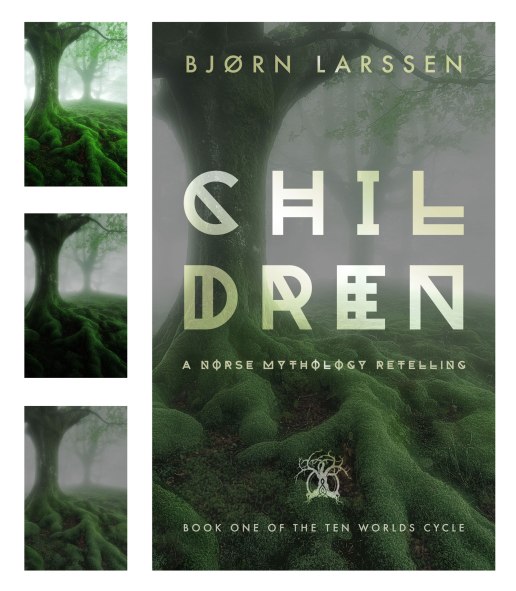 It killed the sales.
There are weeks when I sell more books, then fewer. But when I change nothing but the cover, the number drops to zero, and remains there, it’s easy to guess what the reason could be. I analysed the cover, trying to figure out what I’d done wrong this time. On the thumbnail, the “Norse Mythology Retelling” was illegible. Without that, potential readers saw a blurry, green tree. Their first thought was never going to be, “oh, this is very clearly a grimdark fairytale-like Norse mythology retelling.” I lost the attraction of the red “epic fantasy” tree and failed to convey what the book actually was – again. Oh boy, I thought. If I went with a painted portrait of Magni, I would now be commissioning the fourth painting.
Raven
Back to the photoshopping board we go. Again.
The blurb was fine, but the imagery wasn’t, so the image search and Amazon search became my best friends. Grimdark fantasy. Norse grimdark fantasy. Norse inspired fantasy. Books about Norse mythology. Heathenry symbols. Ásatrú symbols. Viking symbols.
The list I already had seemed, sadly, quite complete. Apart from Odin’s eyepatch I only added Sleipnir, Odin’s eight-legged horse – who makes a brief appearance indeed – and Odin’s ravens, Huginn and Muninn.
In the book, ravens are mostly present because of their absence. My characters’ paranoia about being potentially watched by or listened to by Odin’s ravens is justified. Huginn and Muninn are an extension of Odin; the all-seeing-eyes that might be near… or not. Menacing, dark, fairytale-like – if that fairytale was written by Brothers Grimm on a really cloudy day.
I chose blue that was simultaneously saturated and subdued, moving from fire to ice. The colour was both striking and cold. I added layers of trees, but not pretty, green trees; dark and menacing. The raven himself is a painting I luckily didn’t have to commission. Once I added firefly-like lights, I tested it on a few more people who haven’t read the book, and sighed with relief.
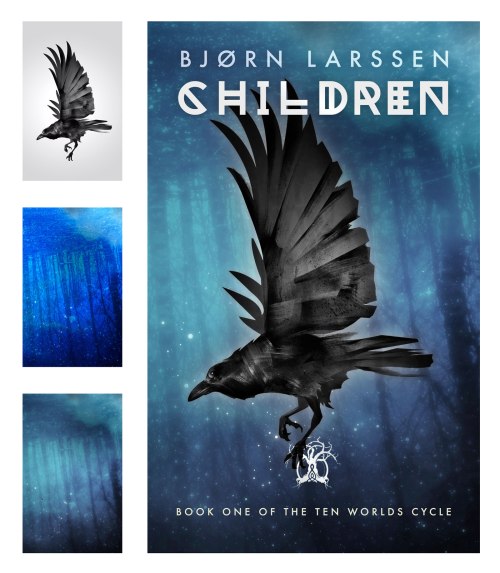
The final (for now) cover couldn’t possibly be more different from what I started with. This one, however, works. And I got another reminder, or three, that cover design is a very different form of art from graphic design.
***
Thanks so much for visiting today, I loved reading about your own book cover journey and hope everyone else does too.
#SPFBO 2018 : Guest Post – Phil Williams, Under Ordshaw
18 August 2018
Filed under Book Reviews
Tags: #SPFBO 2018, Guest post, Minotaurs, Origins, Phil Williams, Under Ordshaw

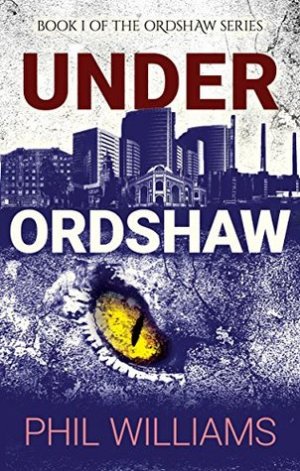
As you may be aware I’m taking part, as one of the judges, in the Self Published Fantasy Blog Off, details here. I’ve invited all the authors from my selected books to pay a visit to my blog and today I’m very pleased to welcome Phil Williams, the author of Under Ordshaw. Phil agreed to write a guest post about how the story came about involving a visit to New York, a few jaunts, getting lost, a labyrinthine hostel and possibly discovering a Minotaur under the city – well, just read the piece already.
The Origins of “Under Ordshaw”
Under Ordshaw takes readers to a UK city with more than a few dark secrets. It’s a city that’s at once familiar and unusual, and the core of a series intended to span dozens of books. It’s the result of years spent writing and rewriting interlinked stories, with a great deal of imagining what if…
It’s also the result of my own attempts to explore our world, and quite specifically the time we considered the possibility of a minotaur under New York.
Under Ordshaw has seen four major iterations – once as a novel, twice as a screenplay and finally the version you see today. Originally called Penguins and Seahorses, it had a plot inspired by my reading that penguins and seahorses are rare in nature as the male helps raise their offspring. The latest version has evolved from a simpler concept of an ordinary father facing the unnatural to protect his family, but the collision of ordinary and unnatural remains.
Recognising that collision was where the story really began.
At some point in life, I adopted a hobby of urban exploring. I placed myself in random places within cities and saw where it took me. What better way to come up with random and absurd stories than to visit places you don’t belong? I got a real taste at university, pottering around the graveyards and estates of Nottingham. I’ve fed it in every city I’ve been.
In the spirit of this mindset, in the Summer of 2006, myself, my brother and my closest friend took a holiday to New York City. We planned nothing, assuming that wandering the Five Boroughs with a travel card would take care of itself.
The holiday panned out in untypical ways, with highlights including narrowly avoiding a major crime scene in Queens and getting lost in the middle of Staten Island. As such explorative jaunts into the unknown stirred our collective imaginations, we happened upon the minotaur.
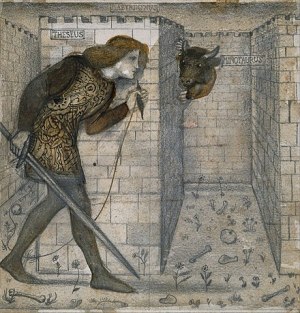 We were staying in a labyrinthine hostel with a kitchen in the basement. Down there, we heard great groans from the mechanics of the buildings. And we asked what if… In particular, what if the next time we heard that noise, someone ran past screaming, “Minotaur!”
In this city that had proved strange and threatening in our ignorance, such a thing seemed possible.
Over the fortnight that we viewed New York through the eyes of outsiders who knew anything was possible, the running joke revealed the minotaur’s lore and the characters that fought or defended it. There was the violent-minded homeless man, perpetually bent on a final showdown with his arch-nemesis: “Rattigan, we finish this now!” (His foe, naturally, the master of the ferocious rodents we’d encountered.) There was the sage Mantis, keeper of secrets. And there was the discovery of scratchitti – urban vandalism, or a way to communicate with the underworld?
This stimulation sowed the seeds that would become Under Ordshaw, after a decade of refining. Similar experiences in different cities added flesh to the tale; the minotaur and the underground fused in my mind, for instance, after watching weary people riding the Prague Metro.
The characters emerged from other moments of inspiration. Darren Barton belongs to the concept of penguins and seahorses; Rufaizu his carefree opposite. Cano Casaria was a necessarily creepy foil in my screenplay Brutal Tower (inspired by research into housing estates, which will live again in Ordshaw Book 5). The criminals of Ordshaw first found life in a school play.
Mid-2016, it clicked in my mind that a shared universe made it possible to connect the many disparate ideas of my contemporary fantasy work that I had never published. Ordshaw was the perfect place to realise it.
When I revisited these stories, and started drawing them together, Pax Kuranes emerged as the character necessary to endure this experience. An outsider to the madness she was about to encounter and, in many ways, an outsider within the city itself. Someone comfortably normal, but drawn to the stranger side of life, open to exploring alleyways at night.
And from this union came Under Ordshaw. A novel that lays the foundations for a lot of work to come, but a story that serves the sentiments of three ill-advised youths who holidayed in New York, intent on seeing it through a different lens.
***
Thank you Phil for writing this fantastic piece, I hope everyone enjoys it as much as I did – apart from the fact that I love discovering the inspiration behind the book – I think what really gave me a smile with this was the ‘what if’ – it’s a favourite phrase of my daughter and I suppose it’s a demonstration of curiosity and imagination at play together.
FYI : Phil can be found at:
www.phil-williams.co.uk Goodreads page
The link for the book is:
https://www.amazon.co.uk/dp/B07CXYSZVN/
My 9th book: Final Stage: #SPFBO 16
24 April 2017
Filed under #SPFBO, Book Reviews
Tags: Assassin's Charge, Claire Frank, Guest post, SPFBO
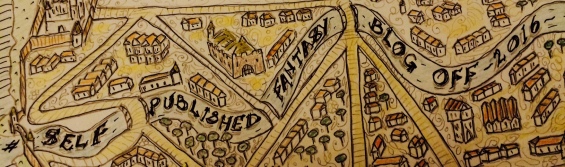 November 1st saw the start of the second stage of the SPFBO – the Self Published Fantasy Blog off organised by Mark Lawrence. All the details can be found here.
Today I’m highlighting the final book that I will be reading for the SPFBO. All the books have been drawn randomly and the books I’ve read so far are as follows:
- Shadow Soul by Caitlyn Davis, review here.
- Paternus by Dyrk Ashton (review here).
- The Grey Bastards by Jonathan French.
- Larcourt K A Krantz ( Fire Born, Blood Blessed #1) My review is here.
- Ráth Bládhma (Fionn mac Cumhaill #1) by Brian O’Sullivan, review here.
- The Music Box Girl by K.A. Stewart. Review here.
- The Path of Flames by Phil Tucker. Review here.
- The Moonlight War by SKS Perry – review to follow.
My final book is :
Assassin’s Charge (Echoes of Imara) by Claire Frank
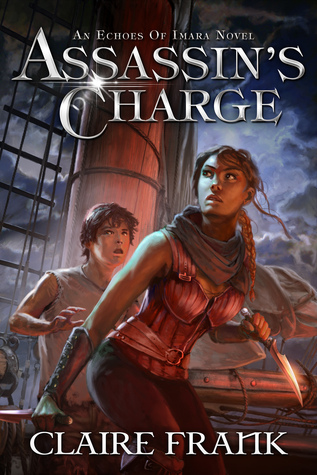 A cold-hearted assassin. A boy with a price on his head.
Rhisia Sen is one of the Empire’s highest paid assassins. Living a life of luxury, she chooses her contracts carefully, working to amass enough wealth so she can leave her bloody trade. She is offered a new contract on the outskirts of civilization, and almost refuses—until she sees the purse. It could be the last job she ever has to take.
But when she reaches the destination, she discovers her mark is a child.
The contract, and her reputation, demand she kill the boy—if she can banish his innocent face from her mind. But another assassin has been sent to kill her, and a notorious bounty hunter is on her trail. She doesn’t know why the boy is a target, or why her former employer wants her dead. Saving the child could be her only chance at survival.
Guest post: Henry L. Herz
11 September 2016
Filed under Book Reviews
Tags: Guest post, Henry L Herz, Mabel and the Queen of Dreams
Today, I’m really pleased to welcome Henry L Herz to my blog. I’ve had the pleasure of reading and reviewing a number of Henry’s book’s in the past. Beyond the Pale is a collection of short fantasy stories from acclaimed authors, including Saladin Ahmed and Peter S Beagle. On top of this Henry also creates some amazing books for children and although I don’t usually review children’s books on my blog I have been pleased to make an exception for the wonderful Monster Goose Nursery Rhymes and When you Give an Imp a Penny. These are beautifully illustrated books, full of imagination and thoroughly enchanting. Henry’s latest book, Mabel and the Queen of Dreams is a beautiful confection (review to follow). Below is a guest post provided by Henry in which he looks at the nature of fairy tales and the role they play in our literature.
Fairy Tales and Fairies and Fae (Oh, My)
Fairy tales are commonly defined as children’s short stories featuring fantasy creatures and magical enchantments. Wikipedia artfully states, “The characters and motifs of fairy tales are simple and archetypal: princesses and goose-girls; youngest sons and gallant princes; ogres, giants, dragons, and trolls; wicked stepmothers and false heroes; fairy godmothers and other magical helpers, often talking horses, or foxes, or birds; glass mountains; and prohibitions and breaking of prohibitions.” The fairy tale is such a ubiquitous literary form, that it even has more than one classification system*.
Thomas Keightley indicated that the word ‘fairy’ derived from the Old French faerie, denoting enchantment. Fae is not related to the Germanic fey, or fated to die. Some authors don’t distinguish between Fae and fairies. Other authors define Fae as any inhabitants of Faërie, be they large or small, good or evil. For them, Fae is the broader term encompassing not only fairies, but elves, dwarves, ogres, imps, and all other fantasy creatures. They consider fairies to be Fae who are diminutive and often ethereal, magic-wielding, and/or winged.
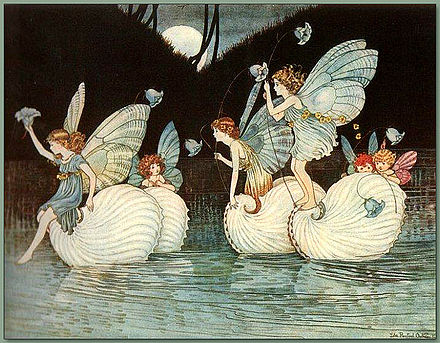
Fairy Islands from Elves and Fairies by Ida Rentoul Outhwaite, 1916
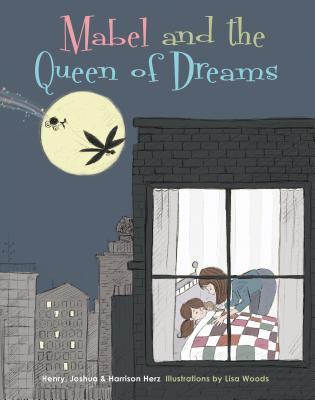
Fairies of either flavor have been flitting about literature for centuries. Consider Morgan le Fay in Le Morte d’Arthur, Edmund Spenser’s The Faerie Queene, Oberon and Titania in Shakespeare’s A Midsummer Night’s Dream, Tinker Bell in J.M. Barrie’s Peter Pan, Holly Short in Eoin Colfer’s Artemis Fowl, all the way up to Bloom in Doreen Cronin’s eponymously titled picture book and Mabel and the Queen of Dreams (inspired by Queen Mab in Shakespeare’s Romeo and Juliet).
C.S. Lewis, J.R.R. Tolkien, and others established fantasy as the subgenre of speculative fiction that employs magical elements set in an alternative world. Tolkien wrote in his essay “On Fairy-Stories” that fairy tales are distinct from traveller’s tales (e.g., Gulliver’s Travels), science fiction, beast tales (e.g., Aesop’s Fables), and dream stories (e.g., Alice in Wonderland). He felt that fairies themselves were not an integral part of the definition of fairy tales. Rather, fairy tales were stories about the adventures of men and fantastic creatures in Faërie, a marvel-filled magical otherworld. By that definition, The Lord of the Rings is a fairy tale.
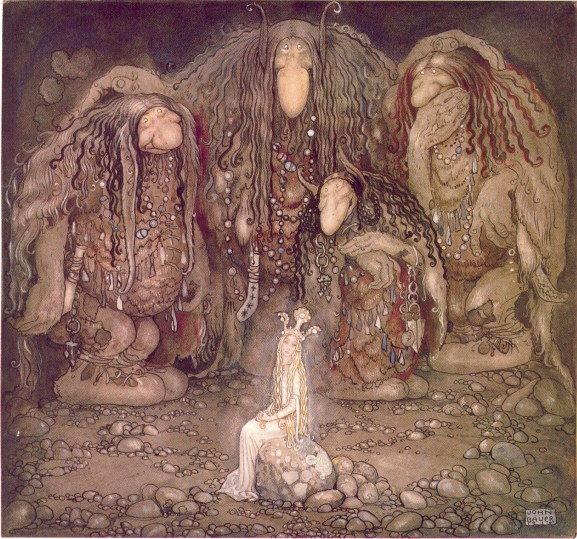
By John Bauer from The Boy and the Trolls, 1915
Urban fantasy** is a subgenre of fantasy set in an urban setting, typically in contemporary times. This setting violates Tolkien’s definition of a fairy tale, since the story takes place in the “real” world, rather than in Faërie. Thus, Mabel and the Queen of Dreams, though featuring a fairy, is an urban fantasy rather than a fairy tale, or as Tolkien preferred, Märchen (wonder tale).
Regardless of subgenre, I hope readers will find in my story what Tolkien posited for Märchen generally. “Far more powerful and poignant is the effect [of joy] in a serious tale of Faërie. In such stories, when the sudden turn comes, we get a piercing glimpse of joy, and heart’s desire, that for a moment passes outside the frame, rends indeed the very web of story, and lets a gleam come through.”
*Two major fairy tale classification systems are Aarne-Thompson and Vladimir Propp’s Morphology of the Folk Tale.
**Some notable urban fantasy includes the Kate Daniels series by Ilona Andrews, Modern Faerie Tales series by Holly Black, Dresden Files series by Jim Butcher, Weather Warden series by Rachel Caine, Mortal Instruments series by Cassandra Clare, Neverwhere by Neil Gaiman, The Southern Vampire Mysteries series by Charlaine Harris, The Hollows series by Kim Harrison, The Iron Druid Chronicles by Kevin Hearne, Feral series by Cynthia Leitich Smith, The Wicked Lovely series by Melissa Marr, October Daye series by Seanan McGuire, Marla Mason series by Tim Pratt, Simon Canderous series by Anton Stout, and Borderlands series by Terri Windling.
Guest post by Michelle Hauck, author of Grudging
Today I’d like to welcome Michelle to my blog. Michelle’s latest book, Grudging, has just been released and is filled with witchcraft. Michelle was kind enough to write me a guest post all about witches and how they fit into her latest novel.
‘Thanks for having me on your blog, Lynn!’
Thanks for agreeing to be my guest 😀
‘It seems proper around this time of year to look at witches in history, literature, and entertainment as I use them myself in my latest book. Witches go back centuries with mentions in the Bible. I think everyone knows from Exodus, “Thou shalt not suffer a witch to live.” In a harking back to the three fates of Greek mythology, Shakespeare used witches in Macbeth as prophets and sinister figures.
Salem had their own real-life run in with “witches” being burned at the stake in Puritan times. For all of history, witches have been women to cast blame upon for unexplained things like the failure of crops, or men who couldn’t stay faithful. Not to get too much into gender discrimination, but the word wizard just doesn’t have the same negative connotation behind it. It was easier to pin problems on the old woman, living alone, without family, than to seek a real explanation in a world without modern science.
But that’s not so much the case anymore in fiction, though the theme of witches shows no sign of slowing down. Sure there are still evil witches in testosterone-filled movies such as the very recent The Last Witch Hunter. But there’s so much variety to witches nowadays. You have the sinister, along with the benign, the romantic, the sexy, and even witches who are neither good nor bad, but somewhere in between.
JK Rowling and Hermoine did a lot to reinvent the idea of witches, giving us a heroic witch. They could be smart, fun, and brave. Hermoine does her fair share of saving other people and is no typical damsel in distress.
I was always partial to Terry Brooks’ Ilse Witch, where a bad witch with powerful magic turns good. One of my favorite witch movies is Hocus Pocus for some family Halloween fun. We even have the comical witch as in Sabrina: The Teenage Witch and Broomhilda from Bugs Bunny.
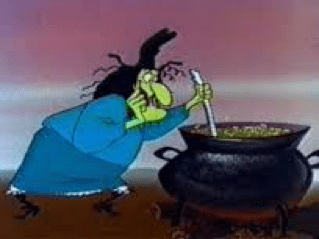
For most of my life, the image from the picture above was my idea of witches. They were ugly, wore pointy hats, rode brooms and did hexes and curses. We all know they keep black cats as part of their familiar bargain with the devil, and warts are how Satan marked them to distinguish them from righteous people. They carry wands and brew stinky potions in their cauldrons.
That’s why when I wrote Grudging and made witches the needed allies for a city under siege from an overwhelming army, I wanted the witches to be different. Oh, the witches in my story live apart in a swamp, but that’s the only typical witch characteristic. My character, Claire, has a cauldron, but she only uses it to brew soap. Instead of black cats, they rear goats. She doesn’t cast hexes or curses. She can’t wither any crops, though she may make the reader fall in love with her.
In Grudging, the people of the city call them witches, those living nearer to the swamps call them more accurately sirena. And Claire calls herself a Woman of the Song. They have voice magic that lets them bewitch and bewilder any man—rumor is unclear whether it works on other women—foolish enough to attack them. All Claire wants is for her mother to relent and let her practice her Song on someone/thing who can hear her.
She’ll get her chance when the city men appear on the scene, bringing their prejudices of witches as a cross between cannibals and temptresses. Can two traditional enemies become friends or just more casualties?
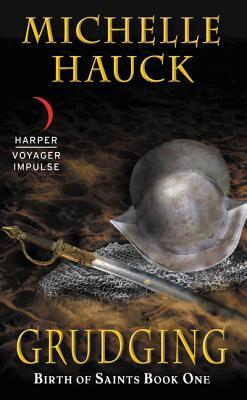
Grudging
A world of chivalry and witchcraft…and the invaders who would destroy everything.
The North has invaded, bringing a cruel religion and no mercy. The ciudades-estados who have stood in their way have been razed to nothing, and now the horde is before the gates of Colina Hermosa…demanding blood.
On a mission of desperation, a small group escapes the besieged city in search of the one thing that might stem the tide of Northerners: the witches of the southern swamps.
The Women of the Song.
But when tragedy strikes their negotiations, all that is left is a single untried knight and a witch who has never given voice to her power. And time is running out.
A lyrical tale of honor and magic, Grudging is the opening salvo in the Book of Saints trilogy.
Release Date: November 17, 2015; Harper Voyager Impulse
Find it: Amazon | Barnes & Noble | iBooks | Goodreads
——————————————-
A little about Michelle:
Michelle Hauck lives in the bustling metropolis of northern Indiana with her hubby and two teenagers. Besides working with special needs children by day, she writes all sorts of fantasy, giving her imagination free range. She is a co-host of the yearly query contests Query Kombat, Nightmare on Query Street, New Agent, PitchSlam, and Sun versus Snow. Her Birth of Saints Series from Harper Voyager starts with GRUDGING on November 17, 2015. Her epic fantasy, KINDAR’S CURE, was published by Divertir Publishing.
Twitter: @Michelle4Laughs
Blog: Michelle4Laughs: It’s in the Details
Facebook: Michelle Hauck, Author
Tumblr: Michelle4Laughs

Thanks again Michelle for writing this guest post.
Whilst we’re thinking about witches – one of my favourites is Tiffany Aching created by Terry Pratchett – which witch is your favourite??


 Books and travelling with Lynn