City of Blades (The Divine Cities #2) by Robert J Bennett

 Unless there’s a new world order in the next 11 months City of Blades will undoubtedly be on my end of year ‘best of’ list. To be honest, I expected this to be good because all the books I’ve read by RJB have been good and I loved City of Stairs last year but this really is so very good.
At the start of the story we are once again introduced to General Turyin Mulaghesh. She’s retired to a small ‘mediterranean’ feeling island and is enjoying her seclusion, particularly when she’s riling up the locals, until she’s rudely jolted out of her retirement by a request from Shara. So Turyin is sent to the City of Voortyashtan – apparently one of the last places in this world that anyone would want to go. Her mission is to try and discover what happened to Choudhry, a Saypuri agent who has gone missing in action.
Before the blink Voortyashtan was home to the Goddess of death, war and destruction. It is now on the brink of becoming a successful seaport however not everyone is happy with the current status. It appears that work on creating a successful gateway is dredging up not just artifacts from the sea bottom but also strong emotions. On top of this brutal and ritualistic type murders are discovered across the island and Turyin is about to be pulled into a plot that not only conjures up the ghosts of her past but also poses a threat to the world in which she lives.
The world building is once again outstanding. Voortyashtan is a difficult place to live to say the least. It seems to be under constant threat of retaliation from the unsecured interior districts. The port itself is protected by an army presence and an imposing fort but any travel further afield is dangerous and not to be lightly undertaken. There is a constant threat of subversive/guerrilla type action that makes any investigation into the goings on even more difficult. Personally I would recommend reading City of Stairs before picking this one up although I think you could probably jump on board with Blades and pick up the story fairly easily. Bennett has a way of gently easing you into the world and feeding you information in a very manageable way. So, whilst I would, of course, recommend reading City of Stairs first (partly because I enjoyed it so much partly because I think it gives a good grounding in the history of the Saypuri’s, Continentals and the Divinities that used to exist) I think this could be read as a standalone.
I must admit that I was at first a little surprised that the author chose to continue this series using Turyin as the main character because Sigrud and Shara were firm favourites for most readers, myself included, but I must say not only does he pull it off but he does so with style and creates one of the most wonderfully complex, flawed, intelligent and easy to root for characters that I’ve read about for a while. I absolutely loved her. The power of good writing and a bit of creative genius, eh!
The other characters who join Turyin along the way are Signe. Signe is another very enjoyable character to read about. She’s an engineering genius by all accounts and seems to be almost single handedly running the entire operation to create a successful seaport. On top of this Signe is Sigrud’s daughter and I can’t say she’s his biggest fan. She hasn’t really forgiven him for what she feels was his abandonment when she was still fairly young and given these feelings the fact that Sigrud makes an appearance during the second half of the book makes for interesting reading. Biswal is another character and something of an unwanted blast from Turyin’s past – this was a dark time in Turyin’s life and a period that has haunted her for many years. Biswal is now the commander at the fort and once again making his acquaintance is going to bring back painful memories.
I can’t really say too much about the plot as it would just give things away. There’s definitely a ‘whodunnit’ type of feel to this book with Turyin investigating the disappearance of an agent until the plot opens up to reveal a much deeper threat. That being said, be aware that this isn’t one of those stories where tens of thousands march to war. It has a more confined feeling, which isn’t intended as a criticism, because Bennett manages to cram in battles, murders, Gods, mines, afterlifes, intrigue, politics, scheming and, well a lot more! It certainly has a different feeling from City of Stairs with much more focus on soldiering and serving which I suppose can be expected as we’re following Turyin. Such a clever device to use Turyin though as it allows Bennett to delve back into the past and reveal more of the history of this world.
Overall, I was quite blown away by City of Stairs. The writing is wonderful, the story is intriguing the characters are excellent to follow, the ending, well, I’m just not going to go there, it’s sad, but also it has an amazing resolution and frankly it just leaves me wanting more. I don’t see how you could have a stronger recommendation than that. More, please, I want more.
I received a copy through Edelweiss courtesy of the publisher for which my thanks. The above is my own opinion.
Vintage Sci Fi: Book No.24
 24 January 2016
Filed under Book Reviews
Tags: Book Covers, Ira Levin, Little Red Reviewer, The Stepford Wives, Vintage Sci Fi
No.24: The Stepford Wives by Ira Levin
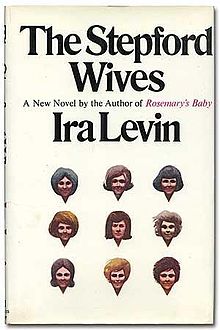
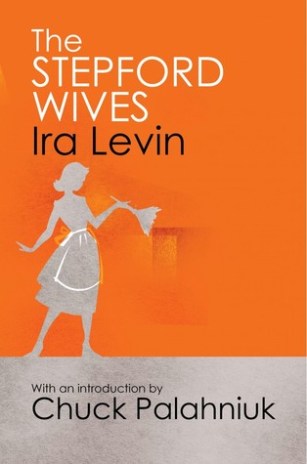
As part of Vintage Sci Fi month being hosted by Little Red Reviewer I’ve given myself a small challenge to post a vintage book each day – one that I’ve read – and to highlight some of the covers. Today’s choice is : The Stepford Wives by Ira Levin. This is one of my ‘is-it-isn’t-it’ sci fi choices. This is a great story though and who among us doesn’t know the ‘Stepford’ term – it’s become quite symbolic. Originally published in 1972 the book leaves the final interpretation fairly vague – unlike the film which definitely sci-fis the story up! Anyway, satire, horror and a little sci fi – I’m going with the brainwashing theme to support that conclusion:
First edition cover:
1972 Library Magna:

1998 Bloomsbury Publishing:

2011 Corsair:
The War of the Worlds by H G Wells
24 January 2016
Filed under Book Reviews
Tags: H G Wells, Little Red Reviewer, The War of the Worlds, Vintage Sci Fi

1927 reprint: Amazing Stories
The War of the Worlds by H G Wells is my first book as part of Vintage Sci Fi being hosted by Little Red Reviewer. I was really looking forward to this as I do love the Time Machine. The TL:DR version of this is that this is a very intriguing novel, it explores a lot of themes, for the time it was written it has great imagination and it certainly helped to spawn a number of other works of sci fi, however, I must confess, that I didn’t enjoy this as much as the Time Machine.
The War of the Worlds is told by an unnamed narrator and recounts the tale from start to conclusion of the invasion of earth by martians from the planet Mars:
‘Yet across the gulf of space, minds that are to our minds as ours are to those of the beasts that perish, intellects vast and cool and unsympathetic, regarded this earth with envious eyes, and slowly and surely drew their plans against us.’
These alien creatures have basically been looking at the earth and their own planet being dry and barren have been coveting something else. And so, using cylinders that are shot from their planet they descend upon our world and wreak havoc with their powerful weapons. Ray guns that incinerate whatever they touch into oblivion and poisonous gases that shroud the countryside killing everyone they touch.
This is without doubt a fascinating story. It is probably a reflection of the period where the threat of invasion was feared. It’s interesting to read the narrator’s thoughts on the aliens themselves. They have developed massively in intellect and consequently have become so intelligent that even compassion seems to have been eliminated. They destroy without feeling, equally without malice, they simply intend to inhabit this world and in doing so will not only kill and obliterate everything that stands against them but also ultimately will use humans the way that humans use beasts of burden.
On the face of it though, and in spite of this novel being called The War of the Worlds, the action is quite confined and limited to London and its surrounding environs where utter destruction and death is inflicted upon the local populace. Obviously the intention would have been to spread further afield and in fact the martians were building flying machines for that very purpose.
We follow in the footsteps of the narrator who along the way encounters a number of people and adventures. Again the narrative takes a strong look at the way that civilisation crumbles very quickly in the wake of such disaster with the saying ‘every man for himself’ being particularly relevant. The storyteller manages to retain a certain amount of self respect and still tries to help people along the way although he reaches a particularly dark period when he becomes thrown into close confines with another person, known as the Curate- who seems to be spiralling into madness.
The story is told in two halves. The first being the invasion when people are trying to fight back or flee the martians. The second half is where people apparently realise that this is a war that they’re not going to win and they start to focus on staying alive, foraging for food and staying under cover.
I did enjoy this book but think I perhaps would have enjoyed it more had I read this before The Time Machine. As it is I think I expected a certain type of writing style which isn’t found here. This is almost a coldly recounted story. There is very little characterisation and the absence of this makes it difficult to feel any real fear or joy for the narrator.
I’m glad I read this though, it is a very compact and inventive story. I was particularly interested to watch how news of the martians was very slow to spread and people even in neighbouring villages seemed to treat the rumours as mere trifles until real disaster struck. We really do take our modern technology for granted I suppose with stories circling the globe in a matter of minutes. It was really intriguing to witness these restrictions written at a time when they were the norm. I leave you with the following (although, be warned if you haven’t read this or seen the adaptations you might want to avoid as it is something of a spoiler):

‘By the toll of a billion deaths man has bought his birthright of the earth, and it is his against all comers; it would still be his were the martians ten times as mighty as they are.’
Kushiel’s Scion by Jacqueline Carey, Readalong week No.4
24 January 2016
Filed under Book Reviews
Tags: Jacqueline Carey, Kushiel's Scion, readalong week 4
 Today is week four of our readalong for Kushiel’s Scion.
If you’re interested in joining the readalong the details and other participants are below. Feel free to join in and obviously, if you haven’t read this series but are intending to do so please be aware of spoilers – because they’re running amok below
This week our host is Lisa at Over the Effing Rainbow. Now, to the Q&A:
1. The aftermath of Imriel’s night at Valerian House takes a bit of a dark emotional turn… What did you think of what happens between him and Phedre? Did it surprise you at all?
It did surprise me and in fact I’m still thinking it over to be honest. I shall have to return to this aspect because I’m not totally sure what to make of it yet.
2. We go from this scene to Imriel’s decision to leave Terre D’Ange and visit Tiberium, and he doesn’t waste much time arranging the trip – though he does make time to say some goodbyes, and to confront Barquiel L’Envers. Any thoughts about this encounter – or his meeting with Sidonie?
The meeting with Sidonie almost felt a little less than I suppose I was hoping for – I think I was hoping that they would both actually show a little more feeling – that being said, I suppose it made sense to rein the feelings in a little. The confrontation with Barquiel – it just seemed to blow up out of nowhere didn’t it – I really wasn’t expecting it – surely Barquiel doesn’t think it would be okay to kill Imriel at Court!
3. Next stop is Tiberium, and Imriel quickly catches up with Eamonn! What do you think of the University setting, and Eamonn’s taste for studying philosophy? Do you think it will help Imri in any way?
I love this aspect of the story so far. We’re once again travelling to a different place and it’s something that Carey really excels at writing. Plus, it was great to catch up with Eamonn again. To an extent it feels like Imriel is floundering – why does he want to go down this route – is he simply following in Eamonn’s footsteps, he does admit that he’s almost envious of Eamonn (not in a bad way) so perhaps he wants to emulate him. But, he seems to have chosen the first tutor he happened upon (who coincidentally was also teaching Eamonn) and he also seems a little flippant about putting in appearance or paying attention – which given that he barely got accepted seems a bit odd. I think, more than anything, Imriel simply needs to escape from himself, enjoy being almost anonymous for a little while, and so whether he’s studying or not maybe doesn’t seem the most important aspect – although, as it’s philosophy I hope he picks up a few pearls of wisdom along the way.
4. An old mystery deepens as Imriel searches for information on Anafiel Delaunay – and appears to find more than he bargained for… What did you make of Claudia Fulvia?
She’s somewhat dangerous I think. She lured Imriel in, got him good and tired (ahem) and then sprung a knife on him – and then tried to make out that she wasn’t going to hurt him – time will tell I think. Maybe her and her husband are both playing a game – it does seem very convenient that he was out of town and he does seem to be completely ignorant of the way his wife is behaving which, given he’s an astute politician I find a little difficult to believe. Let’s see!
That’s it this week.
Here is the current schedule:
And here is the current list of participators:
Allie at Tethyan Books
Lisa at Over the Effing Rainbow
Lynn at Lynn’s Book Blog
Emily at Emma Wolf
Susan at Dab of Darkness
Vintage Sci Fi: Book No.23
23 January 2016
Filed under Book Reviews
Tags: Book Covers, Little Red Reviewer, Robert A Heinlein, The Moon is a Harsh Mistress, Vintage Sci Fi
No.23: The Moon is a Harsh Mistress by Robert A Heinlein
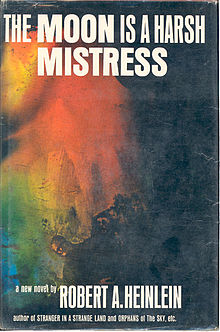
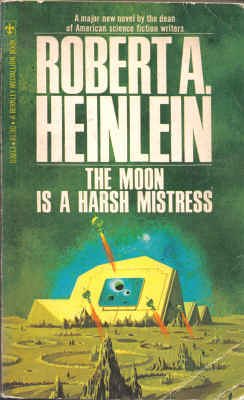
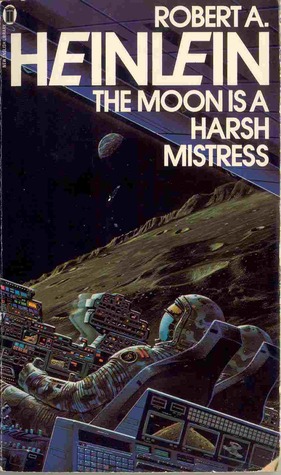
As part of Vintage Sci Fi month being hosted by Little Red Reviewer I’ve given myself a small challenge to post a vintage book each day – one that I’ve read – and to highlight some of the covers. Today’s choice is : The Moon is a Harsh Mistress by Robert A Heinlein. First published in 1966 this story largely takes place on the Moon which is used by the Earth as a self policing penal colony. I think my favourite amongst these covers are the three later ones.
1966 first Edition:
1968 Berkeley:
1979 by NEW ENGLISH LIBRARY:
1981 Berkeley:
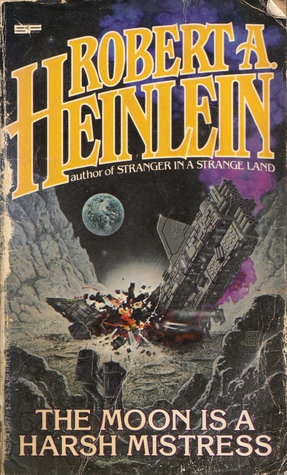
1987 by Ace Books:

1998 by New English Library:

2001 by Gollancz:
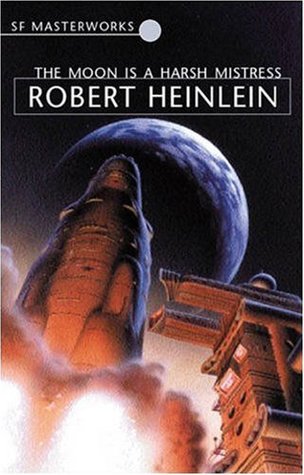
2005 by Hodder & Stoughton:
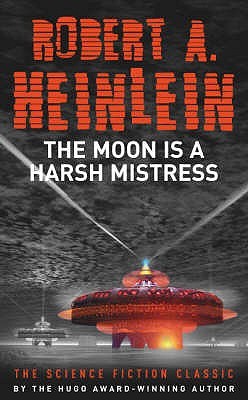
2015 by Hodder & Stoughton: