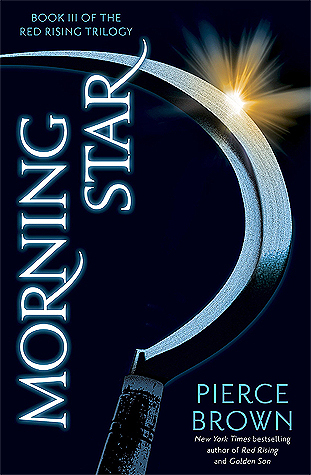
Friday Firsts: Morning Star (Red Rising #3) by Pierce Brown #RRSciFiMonth
 25 November 2016
Filed under Book Reviews
Tags: #RRSciFiMonth, Friday Firsts, Morning Star, Pierce Brown, Red Rising


Friday Firsts is a new meme that runs every Friday over on Tenacious Reader. The idea is to feature the first few sentences/paragraph of your current book and try and outline your first impressions as a result. This is a quick and easy way to share a snippet of information about your current read and to perhaps tempt others. Stop on by and link up with Tenacious Reader. As this month is Sci fi Month 2016 my book today is a science fiction novel that I’ve been wanting to read for some time. I’m very excited to pick this one up as it’s the conclusion to a brilliant series and I need to know how it all ends!!
 I rise into darkness, away from the garden they watered with the blood of my friends. The Golden man who killed my wife lies dead beside me on the cold metal deck, life snuffed out by his own son’s hand.”
Autumn wind whips my hair. The ship rumbles beneath. In the distance, friction flames shred the night with brilliant orange. The Telemanuses descending from orbit to rescue me. Better that they do not. Better to let the darkness have me and allow the vultures to squabble over my paralysed body.
My enemy’s voices echo behind me. Towering demons with the faces of angels. The smallest of them bends. Stroking my head as he looks down at his dead father.
“This is always how the story would end,” he says to me. “Not with your screams. Not with your rage. But with your silence.”
My First Impressions
Well, that’s intriguing. Watch this space!
What are you reading right now? Did it start out strong? Feel free to join in.

Congress of Secrets by Stephanie Burgis
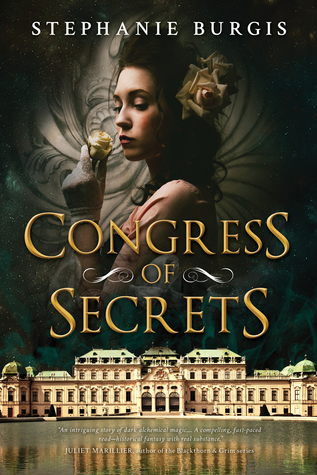 Having fairly recently read and enjoyed Masks and Shadows by Stephanie Burgis I had no hesitation at all in putting in a request for Congress of Secrets. This book definitely does not disappoint and in fact I personally enjoyed it even more than Masks and Shadows. Using real historical events and people Burgis once again brings to us a story that weaves together magic and mystery in a most compelling way.
The year is 1814, Napoleon has fallen and the Congress of Vienna is being hosted by Emperor Francis. A meeting of nobles, ambassadors and royalty with all the ensuing pomp and ceremony that such an occasion would herald. Negotiations for territory are the main order of the day while behind the scenes Vienna is held in the grip of fear, political speech is restricted, secret police maintain strict control over the general populace and dark alchemy is being practiced in the most unexpected places.
This really was a good read. I love this author’s style of writing. She really can set a scene and make it appear effortless. I like how she builds her characters and I think she hits the nail spot on in terms of cutting back and forth between characters to create the maximum tension.
At the heart of this story there are two main protagonists.
Caroline Wyndham is a British noble, intent on meeting the Emperor and offering financial assistance to help him make this Congress an overwhelming success. In reality Caroline was actually born Karolina Vogl. Years before her life was torn apart when her father was arrested by the secret police for sedition and though she was herself taken into captivity at a very young age she subsequently escaped and managed to establish a new life for herself. Twenty years later she has returned, desperate for news about her father.
Prince Kalishnikoff of Kenova is attending the Congress to seek reparation for the loss of his lands during the recent conflicts. In truth he is a charming con artist named Michael Steinhüller. In a strange quirk Michael was perviously a young apprentice to Karolina’s father and the two have not seen each other since the night of the arrest.
The two of them are about to once again meet and they’ll need to keep their heads and their minds focused as their incredibly risky plans become inextricably entwined.
I really enjoyed this story. It’s a wonderful period drama with an intriguing plot, dark magic and a very subtle romance.
Firstly to the characters. Karolina and Michael are very well developed, probably Karolina a little moreso than Michael. Their back stories are only slowly revealed and make for very interesting reading – I won’t go into the ins and outs of them here other than to mention that Karolina seems to have suffered a rather horrible childhood of captivity and torture until her eventual escape. Michael has spent his time going from one con job to the next, relying on his charm but always in the realisation that he can only continue in this vein for so long and becoming desperate to find the perfect job that will enable him to quit. The other key players are the Emperor, an ambitious man who seeks power and wealth and doesn’t mind how low he needs to sink in order to achieve it. His head of Secret Police is Count Pergen, a dark and twisted character who has practiced such dark alchemy that his very soul seems to have been consumed. We also have the involvement of a travelling theatrical company led by the young Peter Riesenbeck – another character who longs for success and hopes to stage his next show at the Congress. Unfortunately Peter unwittingly falls foul of the secret police and becomes embroiled himself in a desperate situation of life and death. My favourite of the piece was probably the wily Prince de Ligne. He doesn’t play one of the main roles but nonetheless he’s a great character. An older man of notoriety, now fallen on slightly harder times due to a disagreement with the new Emperor. I liked him, he’s one of those characters that feels trustworthy and fatherly and I couldn’t help thinking that he would come to the rescue somehow.
In terms of plot. There’s plenty going on here. Political intrigues, two people trying to pull their own perfect con job. A travelling troupe with an ambitious manager and an Emperor who desires power.
In terms of criticisms – well, only a couple of small ones, observations really more than criticisms. Being the second book I’ve read by Burgis I would say that she is great at writing historical novels that twist the real and the fictional into a compelling read. I’m not quite sure that this particular story needed the dark alchemy although it did add the notes of fear and tension – I just wonder if the thought of capture, arrest and torture might have stood just as well – that being said, I do love reading a bit about alchemy and it certainly seems to fit well in a period novel. The other point that I did struggle a little bit with was Karolina’s reason for the visit – I found it difficult to believe in but I can’t really elaborate on why without spoilers.
Other than two very small quibbles I thought this was a thoroughly enjoyable read. A fast paced story with likeable characters and a good deal of tension as their risky cons start to unfold. I do love a good con story and this one is very cleverly done with a great ending.
I would definitely recommend Congress of Secrets. The romance is very subtle and doesn’t overwhelm the story and the fantasy elements similarly don’t take over the plot. Well written with lots of tension and the sort of book that once I finish it I want to go and explore the history of the period a little more – which is exactly what I’ve done now with both books by this author.
I will definitely pick up future books by Burgis and eagerly await her next book.
I received a copy of this from the publishers for which my thanks. The above is my own opinion.
Waiting on Wednesday: Unearthed by Amie Kaufman and Meagan Spooner #RRSciFiMonth
23 November 2016
Filed under Book Reviews
Tags: #RRSciFiMonth, Amie Kaufman, Breaking the Spine, Meagan Spooner, Unearthed, Waiting on Wednesday
 “Waiting On Wednesday” is a weekly meme hosted by Breaking the Spine. Every Wednesday we get to highlight a book that we’re really looking forward to. My book this week is : Unearthed by Amie Kaufman and Meagan Spooner. Basically, I’m being a bit premature with this one as it doesn’t seem to have it’s final cover yet and the publication date isn’t set but I was so happy when I read about this one that I had to feature it. Patience is not a virtue that I seem to possess.

Jules Addison and Amelia Radcliffe join forces in a tomb-raiding race on a newly discovered planet to unravel the secrets of an ancient, long-extinct civilization — only to uncover a revelation that could spell the end of the human race.
…and, okay, it doesn’t really have a full-on blurb yet either … but I don’t care. I like the sound of it – tomb raiding, extinct civilisation, newly discovered planet – oh yes!
Sci Fi Month organised by Rinn Reads and Over the Effing Rainbow is a fun event that celebrates all things sci fi and runs for the whole of November. Check it out and come and join the fun and discussion. You know you want to 😀
Thank you..

Every Tuesday over at the The Broke and Bookish we all get to look at a particular topic for discussion and use various (or more to the point ten) examples to demonstrate that particular topic.
This week is a Thanks Giving freebie. Now, first off, there are a heck of a lot of things that I’m incredibly thankful for – family, friends, health, – lots of things. But I’m going to concentrate simply on those bookish things that I’m thankful for.
- Authors. People with that spark inside them, that determination to write something! I love ya! Think about a world with no books – no matter what sort of book you like to read, fiction, non fiction, romance, fantasy, thriller, chiller, mystery, murder, sff – a world with no books looks pretty bleak!
- Publishers – you’re pretty high up on the list of thanks. You print all of the above – you make us want to pick them up off the shelves with your beautiful covers and your book blurbs.
- ARCs – you have to love advance reader copies. The opportunity to read those books that you love before they hit the shelves – to help spread the word. Its a wonderful thing.
- Request sites – such as Netgalley – tell me how much you love these sites! I love them. Doesn’t everyone! I always have a sense of anticipation when I log on there – it’s like a child walking into a toy story.
- Bloggers – my tbr may have exploded thanks to all of you people but you’re all lovely and without you I would have missed so many good books.
- Fantasy and everything that falls into that bracket. Books, films, games. Goblins, elves – even Sauron!
- Science fiction – ditto the above. Imagine a world with no Star Trek no Star Wars – No Darth! pretty horrible eh?
- Bookshops everywhere – irresistible. Some people are compulsive shoppers, clothes, shoes, bags, jewellery. I’m not interested in all of that but whenever I spot a bookshop, store, stall or even a box with old cast out books – I simply have to look. Call it an addiction if you like but it’s not one that I want to be cured of.
- Libraries – a whole room full of books – that you can temporarily take ownership of, for free! I love libraries!
- Electronic reading devices – I didn’t expect to love you – but you’ve won me over. I can take a whole suitcase of books on holiday with me – without putting any actual book in my suitcase. I can read a heavy 1000 page book just holding it casually in my hand and flipping pages, I can read at the bus stop on a dark evening. I can highlight all sorts of quotes and names easily and I can see a book and buy it within seconds!
Illuminae (The Illuminae Files #1) by Amie Kaufman and Jay Kristoff #RRSciFiMonth
21 November 2016
Filed under Book Reviews
Tags: #RRSciFiMonth, Amie Kaufman, Illumainae, Jay Kristoff, The Illuminae Files #1
 Illuminae is one of those books that I’ve been wanting to read for quite a while. It was recommended to me by a few reliable bloggers so it was definitely on the shelf and yet I was reluctant to get to it. Sci Fi isn’t my first love, I admit, that and coupled with a book aimed more at a YA audience and the possibility that the story focuses quite heavily on romance well I needed a little push and SciFi Month 2016 provided that gentle nudge.
Firstly, to the story. This is definitely a book review that I don’t want to give too much away in. There are plenty of twists and turns to this story and future readers don’t need me to spoil the surprises along the way. I noticed that Kristoff himself gave an excellent synopsis over on Goodreads which basically summaries the story as: girl meets boy, girl loses boy, girl loses planet and family. Girl ends up on a damaged spaceship – with a faster space ship in hot pursuit. On top of this we have a zombie style outbreak taking place on board one of the ships and an AI computer gone insane.
Basically as the story opens we make the acquaintance of Kady and Ezra, their planet is under attack from warships and it doesn’t seem like they’re taking prisoners. Kady and Ezra were in a relationship that literally ended on the evening before the story starts but they’re momentarily flung together as they make a desperate attempt to get off planet in a fleet of ships making a bid to escape. Of course they are once again torn apart and although it takes a little while the two of them make tentative moves to once again establish contact with each other. It seems that the threat of a warship hot on your tail, intent on killing any witnesses is a big incentive in putting things in perspective and bringing people back together.
There’s a lot more to the story than the above of course but Kady and Ezra are the key protagonists that we follow as they not only try to stay alive but also finally reach the conclusion that the people responsible for this attack need to be exposed.
The story is written in epistolary format with briefing notes, messages and surveillance transcriptions lending the story a realistic feel. This is a style that I really enjoy it might not be for everyone but I think it’s a good way of providing the reader with key information without the need to resort to massive info dumps.
What I think really worked well for this story was the build up of momentum. The fleet of escape ships are at a massive disadvantage to the warship pursuing them. They don’t have the speed and the damage sustained during the original attack on the planet of Kerensa has left their hyper jump capacity damaged, on top of this they are incapacitated further by being massively overburdened in terms of the numbers they are now carrying. Throughout the story we watch the progress of the warship with visuals that display how many months/days and hours there are before they are intercepted which helps to heighten the tension for the reader. Meanwhile, the feeling on board the ships trying to escape is desperate. Information is not readily forthcoming and suspicions run deep. All of this coincides with what appears to be a massive break down in the AI onboard one of the ships and running alongside this we start to understand that during the original attack on the planet bio weapons were used and those infected need to be quarantined.
Kady and an acquaintance she has made have turned to hacking the ship’s systems to try and uncover what is really going on. To aid their work they need to make contact with someone on board one of the other vessels and so Kady is forced to reach out to Ezra for help.
The characters – well, I really liked Kady. She’s a very easy to read character. She’s quick witted, intelligent and very cool under pressure – but she has a real person’s flaws. She may be quick at hacking into a computer network but she’s not a ninja. She can unlock doors but doesn’t like to use weapons and she is genuinely afraid when being chased by, well, I won’t go into that! Basically she runs the gamut of emotions and I really liked that about her. Ezra on the other hand is probably a bit more of a simple lad – he calls a spade a spade, he doesn’t have the quick wit of Kady but he’s a good guy and loyal to a fault and I really did feel for the two of them – in fact that was actually what gave me the most tension whilst reading – I so wanted them to get back together and they just kept hitting more and more obstacles to survival. In a reader who cares little for romance that was quite a revelation.
This is a fast paced story with plenty of action. The action is virtually instantaneous from the start of the story and it keeps the momentum right through to the conclusion. That thing about having your heart in your throat – I felt that at a few points whilst reading. I wanted things to go smoothly for this pair – and yet they hit set back after set back.
In terms of criticisms. Well, I didn’t like the layout of the book itself – I understand that it’s something of a work of art but reading on a fairly basic e-reader that doesn’t come across or work well at all. I’m sure it works better on a traditional paper format but this is a niggle of mine, particularly as I read a lot of my books in electronic format these days – I think the book should work in both formats. I’m not going to use this review as the opportunity to rant though as this didn’t really bother me too much as I skipped over the pages in question. Also, I’m not entirely sure that those elements brought anything to the story – others will probably know better on that front.
I thought the ending felt a little bit rushed to be honest. There was an opportunity to make it considerably more tense and to really work on the readers’ emotions even more – perhaps the authors decided they wanted to give us a break.
Overall, niggles aside, I found this a thoroughly enjoyable read. I don’t really read a lot of sci fi so for me the plot and themes involved felt really quite original and very gripping. I suppose hardened sci fi readers might feel differently in that respect.
I would definitely recommend Illuminae, it does have a romance running throughout the plot but because of the way in which the story is told this doesn’t come across as overpowering or ‘cheesy’. There’s no insta-love here, more a realisation of what’s important to the main characters. And, of course there’s the mystery at the heart of the novel – which still remains to be uncovered.
I will definitely pick up No.2 to see where this goes to next. A wonderful story filled with tension and desperation.


